
BUCK BOARD OF TRUSTEES
TABLE OF CONTENTS
2025 Board Meeting Dates:
Thursday, March 13 at 9am
Thursday, June 12 at 9am
Friday, September 26 at 9am
Thursday, December 11 at 9am
Executive Committee
Tuesday, January 21 at 11am
Tuesday, February 18 at 11am
Tuesday, March 25 at 1:30pm
Tuesday, April 15 at 9am
Thursday, May 15 at 9am
Tuesday, June 17 at 9am
Tuesday, July 15 at 9am
Tuesday, August 19 at 9am
Tuesday, October 14 at 11am
Thursday, November 13 at 9am
Tuesday, December 16 at 9am
Finance Committee
Tuesday, March 4 at 9am
Tuesday, June 3 at 11am
Wednesday, September 10 at 10am
Friday, December 5 at 11am
Audit Committee
TBD
Governance & Nominating Committee
Friday, March 7 at 10am
Friday, June 6 at 10am
Friday, September 12 at 10am
Friday, December 5 at 9am
Building & Grounds Committee
Thursday, June 5 at 10am
Thursday, September 4 at 9:30am
Thursday, December 4 at 10am
Legal Requirement to Exercise Fiduciary Duty
Each member of the Board is required to discharge his or her duties in good faith, in a manner that the Board member believes to be in the best interests of the Buck and with such care, including reasonable inquiry, as an ordinarily prudent person would use. This duty to act in good faith and in the best interest of the Buck is also known as “fiduciary duty.” California law explicitly recognizes that in performing the duties of a Board member, you are entitled to rely on information, opinions, reports or statements from officers, employees, counsel, and accountants who you believe to be reliable and competent. You are also entitled to rely on a committee of the Board, if it is acting on matters within its authority, so long as you act in good faith and make reasonable inquiry when the need for inquiry is warranted.
A Board member breaches his or her fiduciary duty if that Board member knowingly allows the Buck to enter into a business transaction with an entity in which he or she has a substantial interest without disclosing that fact to other Board members. The Buck’s conflict of interest policy for trustees and officers is designed to ensure that Board members recognize potential conflicts of interest, disclose them as appropriate, and protect themselves and the Buck from potentially adverse consequences, both real and perceived.
Board members can also breach their fiduciary duty by failing to exercise independent judgment.
Expectations for Individual Members
New Trustee Member Orientation
New members are expected to participate in an orientation program and will communicate with a mentor on the Board to assist them.
Meeting Attendance
Members are strongly encouraged to make every effort to attend quarterly Board meetings in person. While in person attendance is preferred, if necessary, members may participate via video conference. If for whatever reason a Board member fails to attend meetings for a full year, it is the Board’s expectation that individual will vacate his or her position as a member.
Financial Contribution
Board members are expected to provide a minimum personal contribution of $15,000 per year of unrestricted funds during each year of their Board membership. Personal contributions are due on the calendar year beginning three months after joining the Board. It should be noted that to be a “voting member” of the Impact Circle or other restricted gift programs, a separate contribution is required and does not count toward the Board contributions described herein.
Additionally, Board members are asked to “get” a minimum of $15,000 per year of new donations to the Buck. This “get” is tracked by the philanthropy department, using information provided to them by the Board member. The expectation is that Board members will actively work with staff in securing gifts, enthusiastically recruiting new Board members, and expanding the awareness of the Buck and its mission. All Board fund-raising introductions, referrals, and follow-up should be communicated, preferably in writing, to a member of the Buck executive team.
The Board chair may adjust the expectation for individual Board members at his or her discretion, such as members from academia. In exercising that discretion, the chair may consider, among other things:
- The member’s success in obtaining donations to the institute from others
- The member’s unique background and experience that are of significant value to the institute
- The member’s unique and valuable volunteer efforts, other than the regular duties of Board service, that are of significant value to the institute
Expectations for composition of the Board of Trustees
The following characteristics will be inherent in the composition of the Buck Board of Trustees:
Diversity
Every effort should be made to made to select Board members who reflect diversity in ethnicity, age, professional background, and gender.
Achievement
Individuals elected to the Board will have achieved notable success in their professional careers.
Basic Responsibilities
Members of the Board should:
- Familiarize themselves with articles of incorporation and bylaws when a new member joins the Board and periodically thereafter.
- Participate effectively and consistently in Board and committee meetings, asking substantive, appropriate and timely questions.
- Serve on one or more Board committees.
- Accept special assignments.
- Communicate freely with the CEO, providing counsel and advice in their areas of personal expertise.
- Provide and secure the financial support necessary to ensure the continued excellence of the Buck.
- Make a financial contribution each year to the Buck within the context of their personal circumstances, as stated above.
- Comply with the requirements of the conflict-of-interest policy for trustees and officers.
- Interact with the faculty and the administration of the Buck.
- Act as an ambassador on behalf of the Buck.
- Recommend individuals they deem worthy of trusteeship.
Compensation Policy
It is the policy of the Buck not to compensate the members of its Board for services provided as a Board member.
The Buck Institute does not reimburse trustees for travel or lodging expenses incurred in connection with attendance at meetings. Trustees should check with their tax advisors, however, since such expenses may be tax-deductible.
Conflict of Interest Policy for Trustees and Officers
The Board of Trustees has adopted a conflict-of-interest policy for trustees and officers that covers the general standards of conduct expected of the members of its Board related to transactions involving the Buck. The Board of Trustees has also established a requirement that each individual covered by this policy shall annually complete the conflict-of-interest questionnaire provided by the Buck. Questions about the conflict-of-interest policy and the transactions covered by the policy may be directed to the Chief Administrative Officer.
Faculty and Administration Interaction
Although there is no formal requirement in this regard, interaction with the faculty and staff of the Buck is one of the greatest benefits available to members of the Board of Trustees. Attendance at Buck special events will usually provide an opportunity for this interaction.
Mission Statement
Our mission is to end the threat of age-related disease for this and future generations. We believe it is possible for people to enjoy their lives at 95 as much as they do at 25, and to achieve that, we’re seeking a more comprehensive understanding of the biology of aging itself.
Diversity Statement

At the Buck, our commitment to diversity, inclusion and equity is part of our DNA. From our beginning, we have drawn the best and the brightest from all parts of the world. We continually strive to fully represent our changing society and we are committed to bringing racial justice and gender inclusion into our workplace. We want our science to equally benefit all communities, so that everyone, everywhere, can live better longer.
A Brief History of the Buck
The Buck was a pioneer in research on aging, and now we’re a global leader in the field. Opened in 1999, we are the world’s only research institution singularly focused on the biology of aging, yielding insights into age-related diseases before they start. We hire scientists from a variety of disciplines to attack the problem from all sides because the answers we’re after won’t come from a single field. To enhance our process, we worked with world-renowned architect I.M. Pei to create a campus that literally would not allow our researchers to work in silos.
The Buck derives its name from Beryl Hamilton Buck, a philanthropist who lived in Ross, California. When Mrs. Buck died in 1975, she left most of her estate to the San Francisco Foundation with instructions to spend the money for charitable purposes, prominently including “to extend help towards the problems of the aged” in Marin County. A decade of litigation — at times called the “Super Bowl of Probate” and the “Battle of the Bequest” — ensued, with parties attempting to break the Marin-only restriction of the trust.
While the case was still making its way through the courts, eminent Harvard gerontologist John W. Rowe was enlisted to convene a panel of experts to create a plan for a “preeminent research institute in aging.” The court ultimately appointed the Marin Community Foundation as the successor trustee to the San Francisco Foundation and instructed it to provide the Institute with 15 percent of the net income from the Buck estate in perpetuity. When the Buck Institute opened its doors in 1999, it became the first research center in the country to fulfill the challenge of a 1991 National Academy of Medicine report that called for the establishment of at least 10 centers of excellence focused exclusively on research on aging.
Economic Fact Sheet FY 2026
Budget
- The Institute’s operating budget is $67.6 million
Budgeted Sources of Revenue
- Government Grants (NIH/CIRM/DOE) – 57%
- Buck Trust – 12 %
- Philanthropy – 12%
- Business Development – 11%
- Foundation Grants – 3%
- Interest/other (includes leasing) – 5%
Buck Trust Fund Revenue
- The Marin Community Foundation is responsible for distributing funds from the Buck Trust. Based on a 1987 court ruling, the Buck Institute receives 15% of the net distribution from the Trust annually. The Buck Institute anticipates receiving an FY26 allocation of $8 million which will bring the three-year average allocation up to $7.6 million
Expenditures
- Payroll and benefits for FY 2025 totaled approximately $33.1 million.
- All other expenditures for FY 2025 totaled approximately $32.4 million.
Employees
- The Institute has 243 employees.
- 103 (42%) of employees have PhD’s or MD’s; 5 U.S. MDs are on staff.
- 37 countries are currently represented in the employee base; 40% of employees come from countries outside the U.S.
The Buck’s success will ultimately change healthcare. The Buck Institute for Research on Aging aims to end the threat of age-related diseases for this and future generations by bringing together the most capable and passionate scientists from a broad range of disciplines to identify and impede the ways in which we age. An independent, nonprofit institution, its goal is to increase human healthspan, or the healthy years of life. Globally recognized as the pioneer and leader in efforts to target aging, the number one risk factor for serious chronic diseases including Alzheimer’s, Parkinson’s, cancer, macular degeneration, atherosclerosis (heart attack and stroke) , and type 2 diabetes, the Buck wants to help people live better longer. https://buckinstitute.org

OFFICERS
Chair: Matt Carbone
Chair Emeritus: Bill Poland
Vice Chair: Blair LaCorte
Treasurer: Jim Henry
Secretary: Sarah Marsey
Past Chair: Jill Kinney
AUDIT
David Gensler, Chair
John Jack
Darla Flanagan*
Larry Rosenberger*
Staff: Freda Kong**
BUILDING & GROUNDS
Andy Barnes, Chair
Jim Buzzitta
Matt Carbone
David Gensler
Mike Ghilotti
Jim Henry
Jill Kinney
Sarah Marsey
Lew Reid
Staff: Meagan Moore**
FINANCE
Jim Henry, Chair
Andy Barnes
Matt Carbone
Jill Kinney
Blair La Corte
Theo Schwabacher
Lilian Shackelford Murray
Lew Reid
David Gensler – Ad Hoc Member
Staff: Freda Kong**
Faculty: Lisa Ellerby**
GOVERNANCE & NOMINATING
Bill Poland, Co-Chair
Jill Kinney, Co-Chair
Andy Barnes
Matt Carbone
Sarah Marsey
Afaf Meleis
Steven Read
Lilian Shackelford-Murray
Richard Stone
Paul Verkuil
Joon Yun
Staff: Remy Gross**
EXECUTIVE
Matt Carbone, Chair
Blair LaCorte, Vice Chair
Jill Kinney
Peter Fioretti
Jim Henry
Sarah Marsey
Bill Poland
Lew Reid
Jack Rowe
Steven Read
Mark Siegel
Staff: Eric Verdin & Remy Gross**
TECHNOLOGY TRANSFER
John Jack, Chair
Dick Bodman*
Jim Buzzitta
Blair La Corte
Lizellen La Follette
Rona Silkiss*
Paul Verkuil
Robert Rosenkranz
Staff: Remy Gross**
*Prior Board Member
**Non Board Member
| Rob Acker | robertacker1@gmail.com | (415) 254 1784 (mobile) |
| William “Andy” Barnes | wbarnes1600@gmail.com | (415) 505-3200 (mobile) |
| Jim Buzzitta, MD | jim.buzzitta@hughes-mgmt.com | (616) 581-4100 (mobile) |
| Contact: Kelly Bussey | Kelly.bussey@hughes-mgmt.com | (616) 774-0224 (Kelly) |
| Matt P. Carbone | mcarbone@aimpera.com | (415) 505-3353 (mobile) |
| Assistant: Tina White Eagle | twhiteeagle@aimpera.com | (650) 868-2018 (Tina) |
| Peter Fioretti | pfioretti@mountainfunding.com | |
| Assistant: Taylor Sigrist | taylor@mountainfunding.com |
(209) 858-8989 (Taylor) |
| Anisya Fritz | anisya@lynmarestate.com | (415) 533-1228 (mobile) |
| Assistant: Kim Wolf | ea@lynmarestate.com | (510) 710-3222 (Kim) |
| David Gensler | david@genslerventures.com | (310) 699-9953 (mobile) |
| Michael Ghilotti | mikeg@gbi11914.com | (415) 760-0700 (mobile) |
| mikeg@ghilottibros.com | ||
| Jim Henry | jimhenry022@gmail.com | (415) 203-7730 (mobile) |
| Jane Inch | janeinch1@gmail.com | (510) 376-6206 |
| John M. Jack | john@jackfamily.com | (415) 515-5225 (mobile) |
| Jill Kinney | jill.kinney@activewellness.com | (415) 722-2582 (mobile) |
| Lizellen La Follette, MD | lizellen1@gmail.com | (415) 747-6770 (mobile) |
| Assistant: Crystal Murphy | crystal@drlafollette.com | (415) 577-4567 (Crystal) |
| Blair LaCorte | blacorte1@gmail.com | (925) 918-1292 (mobile) |
| Sarah Marsey | smarsey@gmail.com | 415-290-2244 (mobile) |
| sarah.marsey@hklaw.com | ||
| Afaf I. Meleis, PhD, FAAN, LL | meleis@nursing.upenn.edu | (215) 840-0403 (mobile) |
| afaf.meleis@gmail.com | ||
| Jim Mellon | jim@burnbrae.com | +44 7595564582 (mobile) |
| Assistant: Trish Wilson | trish.wilson@burnbrae.com | |
| Bill Poland | bpoland@baywestgroup.net | (415) 314-4600 (mobile) |
| Assistant: David Nguyen | dnguyen@baywestgroup.net | (415) 490-5811 (David) |
| Steven Read | sread@readinvestments.com | (510) 717-2248 (mobile) |
| Assistant: Lynn Skolnick | lskolnick@readinvestments.com | (510) 704-5701 (Lynn) |
| E. Lew Reid | lew@hoghill.net | (707) 921-9455 (mobile) |
| Robert Rosenkranz | ros@dlfi.com | (212) 303-4400 (office) |
| Assistant: Charles Wudd | cwudd@dlfi.com | |
| Jack Rowe, MD | jwr2108@cumc.columbia.edu | |
| Theo Taft Schwabacher | theoschwab@yahoo.com | (415) 828-8938 (mobile) |
| Assistant: Ashley Crigger | Ashley.Crigger@morganstanley.com | (415) 693-6010 (Ashley) |
| Lilian Shackelford Murray | lsm228@att.net | |
| Mark Siegel | msiegel@remyinvestors.com | (310) 843-0050 (office) |
| (310) 990-3897 (cell) | ||
| Richard Stone | richardstone45@gmail.com | (415) 342-3049 (mobile) |
| Paul Verkuil | pverkuil39@gmail.com | |
| Joon Yun | joonyunmd@gmail.com | |
| Assistant: Jennifer Trailer | JTrailer@PA-investors.com |
Non-Voting Trustees
| Eric Verdin, MD | everdin@buckinstitute.org | (415) 305-9208 (mobile) |
| Buck Institute President & CEO | ||
| Ana-Maria Cuervo, MD, PhD | ana-maria.cuervo@einsteinmed.edu | |
| Buck Institute SAB Chair | ||
Alumni Board
| Dorothea M. Dutton, CFA | d2dutton@comcast.net | (415) 722-1102 (mobile) |
| Linda Mayne | mayneco@gmail.com | (415) 847-1346 (mobile) |
| Rona Silkiss, MD, FACS | DrSilkiss@silkisseyesurgery.com | (510) 918-7914 (mobile) |
ARTICLE I INTRODUCTION
The purpose of this Conflict of Interest Policy (Policy) is to foster public confidence in the integrity of the Buck Institute for Research on Aging (the Buck Institute) and to protect the Buck Institute’s interests when it is contemplating entering a transaction that might benefit the private interest of a trustee, officer, or employee.
Certain transactions require disclosure even if they do not give rise to a legal conflict of interest.
ARTICLE II DEFINITIONS
1. Insider means all of the following individuals:
- Each member of the Board of Trustees
- Each Officer, defined in Definitions at the end of the Policy.
- Key Employees, defined in Definitions at the end of the Policy.
2. Interest means any financial or ownership interest, personal or business relationship, obligation, or involvement—whether financial or otherwise, direct or indirect—that may influence a person’s judgment with respect to a decision, transaction, or proposed transaction of the Buck Institute.
3. Transaction means any transaction, agreement, or arrangement between an Insider and the Buck Institute, or between the Buck Institute and any third party where an Insider has an interest in the transaction or an interest in the outcome of the Buck Institute’s decision to engage or not engage in the transaction.
4. A Conflict of Interest is present when an Insider’s interest in the decision or transaction is such that it reduces the likelihood that the Insider’s judgment and influence can be exercised impartially in the best interests of the Buck Institute.
5. A Financial Conflict of Interest is present when an Insider has a conflict of interest and the Insider, or someone with whom the Insider has a close family or intimate relationship, has an interest in the decision or transaction or otherwise stands to financially benefit from the Buck Institute’s decision or transaction.
ARTICLE IV DUTY TO DISCLOSE
Each Insider shall disclose all material facts regarding his or her interest in any decision, transaction or proposed transaction of the Buck Institute, promptly upon learning of the proposed transaction.
1. Insiders (Trustees, Officers, and Key Employees) shall disclose their interests in a transaction or proposed transaction to the Board of Trustees or the Chair of the Board, and to the Chief Executive Officer. Generally, the Executive Committee handles conflicts of interest, but in some cases the full Board of Trustees may be involved. The Committee or the Board will follow the procedures shown below.
2. Employees other than Officers and Key Employees shall disclose their interests in a transaction or potential transaction upon learning of the transaction or proposed transaction to chief executive officer or their direct supervisor, who shall take such action as he or she deems necessary or appropriate under the circumstances to address any actual or potential conflict of interest and protect the Buck Institute’s interests, including ascertaining all material facts, conducting appropriate investigations, and, if necessary, reassigning employee duties to ensure that the interested employee has no decision-making role or inappropriate influence in the transaction.
ARTICLE V PROCEDURES.
1. Evaluating potential conflicts. As soon as is practicable after learning that an Insider (a Trustee, Officer, or Key Employee) has an interest in a decision or proposed transaction of the Buck Institute, the Board or the Executive Committee shall ascertain that (i) all material facts regarding the Insider’s interest have been disclosed to the Board; (ii) evaluate the potential for an actual or perceived conflict of interest, and (iii) determine what actions (if any) are needed to protect the reputation and interests of the Buck Institute. The Board or Executive Committee may ask questions of and receive presentations from the interested person(s), but the interested person(s) may be asked by the person chairing the meeting to leave the meeting during deliberations and/or voting.
2. Financial conflict of interest Procedures. In the case of all compensation arrangements with a principal officer or director, and all other decisions, transactions or proposed transactions where the Board determines that a principal officer or a director has a financial conflict of interest, the Board or Executive Committee shall follow the procedures below to decide whether to enter into the transaction and to ensure that the terms of the transaction are fair to the Buck Institute.
- The Board or the Executive Committee shall require that the interested person leave the meeting during the discussion of, and the vote on, the transaction or arrangement that may create the financial conflict of interest;
- and The Board or Executive Committee shall conduct any investigation necessary to evaluate the transaction, which may include investigating alternatives that present no conflict of interest, and/or compiling appropriate data, such as comparability studies, to determine fair market value for the transaction.
- After exercising due diligence, the Board or Executive Committee shall determine whether proceeding with the transaction is in the Buck Institute’s best interest. Except as otherwise provided in the Buck Institute’s Bylaws or applicable law:
-
- If any Trustee has a material financial interest in the transaction, then the Board may only approve the transaction in conformity with Section 7.03 of the Buck Institute’s Bylaws, which provides that the Board may approve a self-dealing transaction only if the Board finds that the Buck Institute is entering into the transaction for its own benefit; that the transaction is fair and reasonable to the
Buck Institute at the time; and, after reasonable investigation, the Board determines that it could not have obtained a more advantageous arrangement with reasonable effort under the circumstances. Section 7.03 of the Bylaws further requires that the self-dealing transaction be approved by a majority of directors then in office, without counting the vote of the interested director(s). - If no Trustee has a material financial interest in the transaction, the Board or Executive Committee may approve the transaction if it is determined that the Buck Institute is entering into the transaction for its own benefit, and that the transaction is fair and reasonable to the Buck Institute, and if the Board or Executive Committee votes to approve the transaction without counting the votes of any interested Trustees(s).
- If any Trustee has a material financial interest in the transaction, then the Board may only approve the transaction in conformity with Section 7.03 of the Buck Institute’s Bylaws, which provides that the Board may approve a self-dealing transaction only if the Board finds that the Buck Institute is entering into the transaction for its own benefit; that the transaction is fair and reasonable to the
3. Non-financial conflicts of interest Procedures. In any case where an Insider discloses an interest that the Board or Executive Committee does not determine to be a financial conflict of interest (e.g., a Trustee’s volunteer board service with a nonprofit organization that may be party to a transaction with the Buck Institute), the interested person’s disclosure shall be noted in the meeting minutes and the interested person (if a trustee) shall not vote on the transaction. The interested person may be asked by the person chairing the meeting to leave the meeting during Board or Executive Committee deliberations and voting.
4. Other remedial action. The Board or Executive Committee shall take such other action as it deems necessary or appropriate under the circumstances to address any actual or potential conflict of interest (including, for example, revising committee membership or reassigning duties so that an interested committee member or employee has no ongoing role in the transaction).
ARTICLE VI KEEPING MINUTES AND RECORDS
The minutes of any meeting of the Board of Trustees or Executive Committee at which the Board or Executive Committee addressed an Insider’s interest pursuant to this policy shall contain:
- the name of each Insider who disclosed or was otherwise determined to have an interest in a transaction;
- the nature of the interest and whether it was determined to constitute a financial conflict of interest;
- any alternative transactions considered;
- any comparability data or other information obtained and relied upon by the Board and how the information was obtained;
- the members of the Board or Committee who were present during the deliberations on the transaction, those who voted on it, and to what extent interested persons were excluded from the deliberations; and
- the result of the vote, including, if applicable, the terms of the transaction that was approved and the date it was approved.
ARTICLE VII ANNUAL DISCLOSURE AND COMPLIANCE STATEMENTS
1. Annual statements. Each Trustee, Officer, and Key Employee shall annually sign a statement on the form attached that:
- affirms that the person has received a copy of this policy, has read the policy, and has agreed to comply with the policy; and
- discloses the person’s interests (including financial interests and family relationships) that could give rise to a potential or perceived conflict of interest, considering such person’s knowledge of the Buck Institute’s operations, transactions, and proposed transactions.
2. Required IRS Form 990 information. Each Trustee, Officer, and Key Employee shall provide to the Bud Institute’s chief financial officer or outside accountant any information about affiliations, relationships, and compensation that is required to complete the Buck Institute’s Form 990 tax return or other required tax filing.
ARTICLE VIII VIOLATIONS
If the Chair of the Board, the Executive Committee, the Board, or the Chief Executive Officer has reasonable cause to believe that an Insider of has failed to disclose actual or possible conflicts of interest, they shall inform such Insider of the basis for this belief and afford the Insider an opportunity to explain the alleged failure to disclose. If, after hearing the Insider’s response and making further investigation as warranted by the circumstances, the Board or Executive Committee determines that the Insider has failed to disclose an actual or possible conflict of interest, the Board or Executive Committee shall take appropriate disciplinary and corrective action.
ARTICLE IX POLICY REVIEWS
To ensure that the Buck Institute operates in a manner consistent with its status as a section 501(c)(3) organization, the Board or a committee shall conduct periodic reviews of the administration of this Conflict of Interest Policy, which shall consider the level of compliance with the policy, the continuing suitability of the policy, and whether the policy should be modified and improved
ANNUAL DISCLOSURE OF INTERESTS FOR TRUSTEES, OFFICERS, AND KEY EMPLOYEES
& ACKNOWLEDGMENT OF RECEIPT
Confidential Responses. Your responses are confidential and will generally be shared only with the Chair of the Board, the Chief Executive Officer of the Buck Institute, and EVP Administration. If further disclosure of your interests is needed for any reason and in the discretion of the Chair of the Board or the Chief Executive Officer, such disclosures will be made in a manner to maintain confidentiality of the information.
- You have been provided a list of grantees, vendors, officers, and Key Employees of the Buck Institute during the Certification Period (defined below). [Chief Executive Officer or staff to provide the list.]
- Please consider each of the following questions as of the Certification Period.
- Words capitalized and bolded are defined in the Definitions section, below.
Certification Period: July 1 – June 30 of the prior year and July 1 of the current year through today’s date.
PLEASE COMPLETE THE CONFLICT OF INTEREST FORM. (Click the blue text)
DEFINITIONS
“Business Relationship” between two persons includes any of the following:
• One person is employed by the other in a sole proprietorship or by an organization for which the other person is a Director, Trustee, Officer, Key Employee, or a greater-than-35% owner
• One person is transacting business with the other (other than in the ordinary course of business of either party’s business on the same terms as are generally offered to the public), directly or indirectly, in one or more contracts of sales, lease, license, loan, performance of services, or other transactions involving transfers of cash or property valued in excess of $10,000 in the aggregate during the Buck Institute’s fiscal year. Indirect transactions are transactions with an organization with which the one person associated is a Director, Trustee, Officer, Key Employee, or a greater-than-35% owner.
• The two persons are each a Director, Trustee, Officer, or a greater-than-35% owner in the same business or investment entity.
“Business Relationship” for this purpose excludes relationships in the ordinary course of business (that is, on terms generally offered to the public) as well as privileged relationships (attorney/client, medical professional/patient, clergy/communicant).
“Business transactions” include (a) contracts of sale, lease and licensing, and performance of services, whether entered into in the current year or ongoing from a prior year, and/or (b) joint ventures in which either the profits or capital interest of the Buck Institute and the Interested Person exceeds 10%.
“Trustee” means member of the Board of Trustees of the Buck Institute, as determined by reference to the Buck Institute’s bylaws and applicable California law.
“Family Member” means your spouse, ancestors, brothers and sisters (whether whole or half), children (whether natural or adopted), grandchildren, great-grandchildren, and spouses of your brothers, sisters, children, grandchildren and great-grandchildren.
“Family Relationship” means your spouse, ancestors, brothers and sisters (whether whole or half), children (whether natural or adopted), grandchildren, great-grandchildren, and spouses of your brothers, sisters, children, grandchildren and great-grandchildren.
“Interested Person” means:
- A current Trustee or a Family Member of a current Trustee
- An entity more than 35% owned, directly or indirectly, individually or collectively, by (a) one or more current Trustees and/or their Family Members
- An entity (other than a nonprofit organization) of which the current or former Officer, Trustee, or Key Employee of the Buck Institute was serving as (a) an officer, (b) a director, (c) a trustee, (d) a key employee, (e) a partner or member with an ownership interest in excess of 5% if the entity is treated as a partnership, or (f) a shareholder with an ownership interest in excess of 5% if the entity is a corporation
“Key Employee” means a Buck Institute employee who meets all of the following tests applied in the following order:
1. $150,000 Test. Receives compensation from the Buck Institute in excess of $150,000 for the calendar year ending with or within the Buck Institute’s tax year.
2. Responsibility Test. The employee (a) has responsibilities, powers, or influence over the Buck Institute similar to an officer or director; or (b) manages a discrete segment or activity of the Buck Institute that represents 10% or more of the activities, assets, income, or expenses of the Buck Institute; or (c) has or shares authority to control or determine 10% or more of the Buck Institute’s capital expenditures, operating budget, or compensation for employees.
3. Top 20 Test. Is one of the 20 employees who satisfy both the $150,000 Test and the Responsibility Test with the highest reportable compensation from the Buck Institute for the calendar year ending with or within the Buck Institute’s tax year.
“Officer” means the Chair of the Board, Vice Chair, Secretary, Treasurer, President (Chief Executive Officer), Chief Administrative Officer, and Chief Financial Officer.
“Related person” means:
• A Family Member of a Trustee (spouse, ancestors, brothers and sisters (whether whole or half), children (whether natural or adopted), grandchildren, great-grandchildren, and spouses of brothers, sisters, children, grandchildren and great-grandchildren
• A corporation, partnership, trust or estate in a Trustee or Trustee’s Family Member owns more than 35% of the combined voting power, profits interest or beneficial interest (a “35% controlled entity”)
• An employee (or child of an employee) of a substantial contributor or of a 35% controlled entity of a substantial contributor, but only if the employee (or child) received the grant or assistance by the direction or advice of a substantial contributor or 35% controlled entity, pursuant to a program funded by the substantial contributor that was intended primarily to benefit such employees (or their children)
Ways to Give
Outright Gifts
GIFTS OF CASH
A common and straightforward way to make a gift. Cash gifts in the form of check, credit card or wire can be deducted – up to 60% of Adjusted Gross Income (AGI).
GIFTS OF APPRECIATED SECURITIES
Gifts of stocks, bonds, and mutual funds receive double benefit: income tax deduction available for Fair Market Value (FMV) of assets for up to 30% of AGI; and no capital gains tax paid when securities sold.
GIFTS OF REAL ESTATE
FMV income tax deduction available for up to 30% of AGI; no capital gains tax paid; can be combined with other tools (e.g., charitable remainder trusts and retained life estates).
GIFTS OF BUSINESS INTERESTS
Gifts of closely held stock; the Buck would then offer the stock back to the company for redemption or repurchase. Tax treatment identical to gifts of appreciated securities.
GIFTS OF PARTNERSHIP INTERESTS
Similar to a gift of closely held stock; Buck Institute may continue to hold the partnership interest or sell it.
GIFTS OF PERSONAL PROPERTY
Can include artwork, antiques, collectibles, or other personal property; may receive income tax deduction for FMV if “related use” requirements are met.
Estate Gifts
GIFTS BY WILL OR LIVING TRUST
Gifts should be made to BUCK INSTITUTE FOR RESEARCH ON AGING.
Charitable estate tax deduction available for 100% of gift.
Example of unrestricted bequest language: “I give, devise, and bequeath to The Buck Institute for Research on Aging, TAX I.D. #94-3030609, all [or state the fraction or percentage] of the rest, residue, and remainder of my estate, both real and personal.”
GIFTS OF RETIREMENT PLANS
Name the Buck as the beneficiary of an IRA, 401(k) or other qualified plan. The residual left in the plan goes to Buck tax-free.
The IRA Qualified Charitable Distribution (QCD) allows individuals aged 70 ½ or older to make outright gifts of as much as $100k annually to Buck from a traditional IRA. The withdrawal amount may count toward your annual required minimum distribution (RMD).
GIFTS OF LIFE INSURANCE
Transfer ownership of paid-up life insurance to the Buck, or name Buck as the beneficiary of a portion of the death benefit of any policy. If a policy is transferred, the Buck may decide to cash in the policy or keep the policy and receive the death benefit later.
Gifts in Partnership
CHARITABLE LEAD TRUSTS (CLT)
A gift of cash or other property is transferred to an irrevocable trust; the trust makes fixed annual payments to the Buck for a designated number of years. When the trust term ends the remaining principal goes to heirs.
With a charitable lead trust, you can make annual gifts to support an area of interest to you at Buck for a term of years, typically between 10 and 20.
In a low interest rate environment, CLT’s can provide a tax-effective means for giving to charity while retaining the ability to transfer wealth to heirs in a tax-advantaged manner.
CHARITABLE REMAINDER TRUSTS (CRT)
Like a CLT, a gift of cash or other property is directed to an irrevocable trust. However, in the case of a CRT the donor, or someone named by the donor, receives an annual income stream from the trust for a term of years or for life, and the Buck receives the remaining trust assets at the end of the trust term.
In addition to an annual income stream from the gifted assets, donors receive an immediate income tax charitable deduction and pay no capital gains tax at the time of gift.
The remainder interest, or balance of the assets when the trust terminates, may be used to create an endowment or to support specific areas of interest.
June 7, 2024 Finance Committee minutes
March 8, 2024 Finance Committee minutes
Dec 8, 2023 Finance Committee minutes
Oct 23, 2023 Audit Committee minutes
June 2, 2023 Audit Committee minutes
June 9, 2023 Finance Committee minutes
March 10, 2023 Finance Committee minutes
Sept 1, 2023 Finance Committee minutes
July 22, 2025 Governance and Nominating Committee minutes
Sept 12, 2025 Governance and Nominating Committee minutes
|
Job Title |
Name |
Phone Number |
Email Address |
|
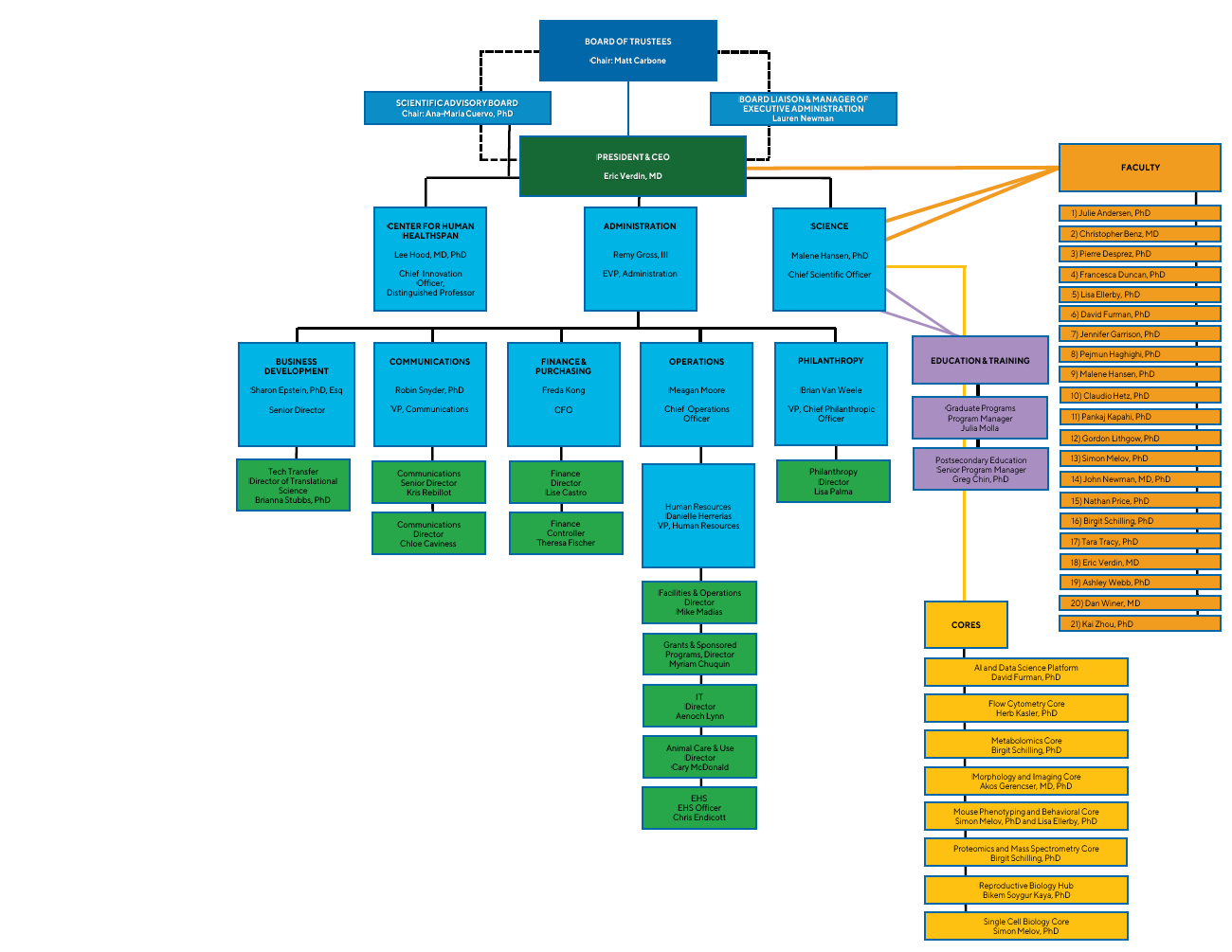
President and CEO |
Eric Verdin, MD |
415-305-9208 |
|
|
Chief Scientific Officer |
Malene Hansen, PhD |
415-336-6588 |
|
|
Chief Innovation Officer |
Lee Hood, MD, PhD |
206-406-1366 |
|
|
Chief Operations Officer |
Meagan Moore |
805-708-0863 |
|
|
Vice President, Communications |
Robin Snyder, PhD |
415-420-9905 |
|
|
Executive VP, Administration |
Remy Gross III |
256-783-4143 |
|
|
VP, Chief Philanthropic Officer |
Brian Van Weele |
415-606-1405 |
|
|
VP, Human Resources |
Danielle Herrerias |
415-302-8604 |
|
|
Chief Financial Officer |
Freda Kong, CPA |
415-373-8778 |
|
|
Manager of Executive Administration |
Lauren Newman |
707-489-6436 |
|
|
EA to Remy Gross |
JM Reyes |
707-241-4399 |
|
|
EA to Chief Scientific Officer |
Anne Waggoner |
510-520-2399 |
Buck Publications
August 2024
Molecular Mechanisms of Autophagy Decline during Aging.
Lim SHY, Hansen M, Kumsta C.Cells. 2024 Aug 16;13(16):1364. doi: 10.3390/cells13161364.PMID: 39195254 Review.
Ketone monoester attenuates declines in cognitive performance and oxygen saturation during acute severe hypoxic exposure under resting conditions.
McClure TS, Phillips J, Koutnik AP, Coleman K, Chappe E, Cutter GR, Egan B, Norell T, Stubbs BJ, Bamman MM, Kernagis D.Exp Physiol. 2024 Aug 27. doi: 10.1113/EP091794. Online ahead of print.PMID: 39190580
Ketone monoester attenuates oxygen desaturation during weighted ruck exercise under acute hypoxic exposure but does not impact cognitive performance.
McClure TS, Phillips J, Kernagis D, Coleman K, Chappe E, Cutter GR, Egan B, Norell T, Stubbs BJ, Bamman MM, Koutnik AP.Exp Physiol. 2024 Aug 27. doi: 10.1113/EP091789. Online ahead of print.PMID: 39190570
Obesity intensifies sex-specific interferon signaling to selectively worsen central nervous system autoimmunity in females.
Cordeiro B, Ahn JJ, Gawde S, Ucciferri C, Alvarez-Sanchez N, Revelo XS, Stickle N, Massey K, Brooks DG, Guthridge JM, Pardo G, Winer DA, Axtell RC, Dunn SE.Cell Metab. 2024 Aug 20:S1550-4131(24)00288-2. doi: 10.1016/j.cmet.2024.07.017. Online ahead of print.PMID: 39168127 Free article.
Stem cell transcriptional profiles from mouse subspecies reveal cis-regulatory evolution at translation genes.
Simon NM, Kim Y, Bautista DM, Dutton JR, Brem RB.Heredity (Edinb). 2024 Aug 20. doi: 10.1038/s41437-024-00715-z. Online ahead of print.PMID: 39164520
Hypoxia decreases mitochondrial ROS production in cells.
Sen B, Benoit B, Brand MD. Free Radic Biol Med. 2024 Aug 13;224:1-8. doi: 10.1016/j.freeradbiomed.2024.08.016. Online ahead of print.PMID: 39147069 Free article.
Daily consumption of ketone ester, bis-octanoyl (R)-1,3-butanediol, is safe and tolerable in healthy older adults in a randomized, parallel arm, double-blind, placebo-controlled, pilot study.
Stubbs BJ, Stephens EB, Senadheera C, Peralta S, Roa-Diaz S, Alexander L, Silverman-Martin W, Garcia TY, Yukawa M, Morris J, Blonquist TM, Johnson JB, Newman JC.J Nutr Health Aging. 2024 Aug 12;28(9):100329. doi: 10.1016/j.jnha.2024.100329. Online ahead of print.PMID: 39137624 Free article.
Bringing Geroscience into the Mainstream: From Education to Clinical Practice, What Will It Take?
Al-Naggar IM, Campellone KG, Espinoza SE, Justice JN, Orr ME, Kozikowski C, van der Willik O, Thatcher C, Schmader K, Pignolo RJ, Newman JC, Kuchel GA.J Gerontol A Biol Sci Med Sci. 2024 Sep 1;79(9):glae020. doi: 10.1093/gerona/glae020.PMID: 39126344 No abstract available.
Characteristics, Complications, and Outcomes of Critical Illness in Patients with Parkinson Disease.
Lieberman OJ, Douglas VC, LaHue SC.Neurocrit Care. 2024 Aug 7. doi: 10.1007/s12028-024-02062-7. Online ahead of print.PMID: 39112816
Role of the National Institute on Aging in Transforming Aging Research Through Geroscience and Gerotherapeutics-50 Years of Innovation.
Newman JC, Al-Naggar IM, Kuchel GA.JAMA Intern Med. 2024 Aug 5. doi: 10.1001/jamainternmed.2024.2534. Online ahead of print.PMID: 39102243
Development of an epigenetic clock resistant to changes in immune cell composition.
Tomusiak A, Floro A, Tiwari R, Riley R, Matsui H, Andrews N, Kasler HG, Verdin E.Commun Biol. 2024 Aug 2;7(1):934. doi: 10.1038/s42003-024-06609-4.PMID: 39095531 Free PMC article.
Characterizing phenotypic data of Peromyscus leucopus compared to C57BL/6J Mus musculus and diversity outbred (DO) Mus musculus.
Wimer LA, Davis-Castillo A, Galkina S, Ciotlos S, Patterson C, Prado L, Munoz MC, Martin N, Epstein S, Schaum N, Melov S.Geroscience. 2024 Oct;46(5):4647-4656. doi: 10.1007/s11357-024-01175-3. Epub 2024 Jun 14.PMID: 38871964 Free PMC article.
A Fully-Automated Senescence Test (FAST) for the high-throughput quantification of senescence-associated markers.
Neri F, Takajjart SN, Lerner CA, Desprez PY, Schilling B, Campisi J, Gerencser AA.Geroscience. 2024 Oct;46(5):4185-4202. doi: 10.1007/s11357-024-01167-3. Epub 2024 Jun 13.PMID: 38869711 Free PMC article.
Amyloid β accelerates age-related proteome-wide protein insolubility.
Anderton E, Chamoli M, Bhaumik D, King CD, Xie X, Foulger A, Andersen JK, Schilling B, Lithgow GJ.Geroscience. 2024 Oct;46(5):4585-4602. doi: 10.1007/s11357-024-01169-1. Epub 2024 May 16.PMID: 38753231 Free PMC article.
July 2024
A Multiomics, Molecular Atlas of Breast Cancer Survivors.
Bauer BA, Schmidt CM, Ruddy KJ, Olson JE, Meydan C, Schmidt JC, Smith SY, Couch FJ, Earls JC, Price ND, Dudley JT, Mason CE, Zhang B, Phipps SM, Schmidt MA.Metabolites. 2024 Jul 20;14(7):396. doi: 10.3390/metabo14070396.PMID: 39057719 Free PMC article.
Aberrant bowel movement frequencies coincide with increased microbe-derived blood metabolites associated with reduced organ function.
Johnson-Martínez JP, Diener C, Levine AE, Wilmanski T, Suskind DL, Ralevski A, Hadlock J, Magis AT, Hood L, Rappaport N, Gibbons SM.Cell Rep Med. 2024 Jul 16;5(7):101646. doi: 10.1016/j.xcrm.2024.101646.PMID: 39019013 Free article.
The infrapatellar fat pad in inflammaging, knee joint health, and osteoarthritis.
Wang MG, Seale P, Furman D.NPJ Aging. 2024 Jul 15;10(1):34. doi: 10.1038/s41514-024-00159-z.PMID: 39009582 Free PMC article. Review.
Microbial community-scale metabolic modelling predicts personalized short-chain fatty acid production profiles in the human gut.
Quinn-Bohmann N, Wilmanski T, Sarmiento KR, Levy L, Lampe JW, Gurry T, Rappaport N, Ostrem EM, Venturelli OS, Diener C, Gibbons SM.Nat Microbiol. 2024 Jul;9(7):1700-1712. doi: 10.1038/s41564-024-01728-4. Epub 2024 Jun 24.PMID: 38914826
Succinylation of Park7 activates a protective metabolic response to acute kidney injury.
Pfister K, Young V, Frankel B, Silva Barbosa A, Burton J, Bons J, Zhang B, Chiba T, Uhlean R, Goetzman E, Schilling B, Sims-Lucas S.Am J Physiol Renal Physiol. 2024 Jul 1;327(1):F128-F136. doi: 10.1152/ajprenal.00062.2024. Epub 2024 May 2.PMID: 38695076
A Brief History of Slow Spinal Potentials, Gate Theory of Pain, and Spinal Cord Stimulation.
Bikson M, Sharma M. Neuromodulation. 2024 Jul;27(5):946-948. doi: 10.1016/j.neurom.2023.12.001. Epub 2024 Apr 1.PMID: 38573281 No abstract available.
Navigating the Landscape of Translational Geroscience in Canada: A Comprehensive Evaluation of Current Progress and Future Directions.
Hajj-Boutros G, Faust A, Muscedere J, Kim P, Abumrad N, Chevalier S, Aubertin-Leheudre M, Bergman H, Bowdish D, Burford J, Carrington-Lawrence S, Côté H, Dawe DE, Barreto PS, Farrelly C, Fowler R, Gouspillou G, Harrington L, Lautrup S, Howlett S, Imani M, Kirkland J, Kuchel G, Mallette FA, Morais JA, Newman JC, Pullman D, Sierra F, Van Raamsdonk J, Watt J, Rylett RJ, Duque G.J Gerontol A Biol Sci Med Sci. 2024 Jul 1;79(7):glae069. doi: 10.1093/gerona/glae069.PMID: 38486371 Free PMC article.
Neuronal waste management: new roles for autophagy genes in the extrusion of protein aggregates and in longevity.
Sun LH, Lange CM, Hansen M, Kumsta C.Autophagy. 2024 Jul;20(7):1681-1683. doi: 10.1080/15548627.2024.2322420. Epub 2024 Mar 6.PMID: 384111
June 2024
SenNet recommendations for detecting senescent cells in different tissues.
Suryadevara V, Hudgins AD, Rajesh A, Pappalardo A, Karpova A, Dey AK, Hertzel A, Agudelo A, Rocha A, Soygur B, Schilling B, Carver CM, Aguayo-Mazzucato C, Baker DJ, Bernlohr DA, Jurk D, Mangarova DB, Quardokus EM, Enninga EAL, Schmidt EL, Chen F, Duncan FE, Cambuli F, Kaur G, Kuchel GA, Lee G, Daldrup-Link HE, Martini H, Phatnani H, Al-Naggar IM, Rahman I, Nie J, Passos JF, Silverstein JC, Campisi J, Wang J, Iwasaki K, Barbosa K, Metis K, Nernekli K, Niedernhofer LJ, Ding L, Wang L, Adams LC, Ruiyang L, Doolittle ML, Teneche MG, Schafer MJ, Xu M, Hajipour M, Boroumand M, Basisty N, Sloan N, Slavov N, Kuksenko O, Robson P, Gomez PT, Vasilikos P, Adams PD, Carapeto P, Zhu Q, Ramasamy R, Perez-Lorenzo R, Fan R, Dong R, Montgomery RR, Shaikh S, Vickovic S, Yin S, Kang S, Suvakov S, Khosla S, Garovic VD, Menon V, Xu Y, Song Y, Suh Y, Dou Z, Neretti N.Nat Rev Mol Cell Biol. 2024 Jun 3. doi: 10.1038/s41580-024-00738-8. Online ahead of print.PMID: 38831121 Review.
Effects of intensive lifestyle changes on the progression of mild cognitive impairment or early dementia due to Alzheimer’s disease: a randomized, controlled clinical trial.
Ornish D, Madison C, Kivipelto M, Kemp C, McCulloch CE, Galasko D, Artz J, Rentz D, Lin J, Norman K, Ornish A, Tranter S, DeLamarter N, Wingers N, Richling C, Kaddurah-Daouk R, Knight R, McDonald D, Patel L, Verdin E, E Tanzi R, Arnold SE.Alzheimers Res Ther. 2024 Jun 7;16(1):122. doi: 10.1186/s13195-024-01482-z.PMID: 38849944 Free PMC article. Clinical Trial.
A Second Space Age Spanning Omics, Platforms, and Medicine Across Orbits.
Mason CE, Green J, Adamopoulos KI, Afshin EE, Baechle JJ, Basner M, Bailey SM, Bielski L, Borg J, Borg J, Broddrick JT, Burke M, Caicedo A, Castañeda V, Chatterjee S, Chin C, Church G, Costes SV, De Vlaminck I, Desai RI, Dhir R, Diaz JE, Etlin SM, Feinstein Z, Furman D, Garcia-Medina JS, Garrett-Bakelman F, Giacomello S, Gupta A, Hassanin A, Houerbi N, Irby I, Javorsky E, Jirak P, Jones CW, Kamal KY, Kangas BD, Karouia F, Kim J, Kim JH, Kleinman A, Lam T, Lawler JM, Lee JA, Limoli CL, Lucaci A, MacKay M, McDonald JT, Melnick AM, Meydan C, Mieczkowski J, Muratani M, Najjar D, Othman MA, Overbey EG, Paar V, Park J, Paul AM, Perdyan A, Proszynski J, Reynolds RJ, Ronca AE, Rubins K, Ryon KA, Sanders LM, Glowe PS, Shevde Y, Schmidt MA, Scott RT, Shirah B, Sienkiewicz K, Sierra M, Siew K, Theriot CA, Tierney BT, Venkateswaran K, Hirschberg JW, Walsh SB, Walter C, Winer DA, Yu M, Zea L, Mateus J, Beheshti A.Nature. 2024 Jun 11. doi: 10.1038/s41586-024-07586-8. Online ahead of print.PMID: 38862027 Review.
The Space Omics and Medical Atlas (SOMA) and international astronaut biobank.
Overbey EG, Kim J, Tierney BT, Park J, Houerbi N, Lucaci AG, Medina SG, Damle N, Najjar D, Grigorev K, Afshin EE, Ryon KA, Sienkiewicz K, Patras L, Klotz R, Ortiz V, MacKay M, Schweickart A, Chin CR, Sierra MA, Valenzuela MF, Dantas E, Nelson TM, Cekanaviciute E, Deards G, Foox J, Narayanan SA, Schmidt CM, Schmidt MA, Schmidt JC, Mullane S, Tigchelaar SS, Levitte S, Westover C, Bhattacharya C, Lucotti S, Hirschberg JW, Proszynski J, Burke M, Kleinman A, Butler DJ, Loy C, Mzava O, Lenz J, Paul D, Mozsary C, Sanders LM, Taylor LE, Patel CO, Khan SA, Suhail M, Byhaqui SG, Aslam B, Gajadhar AS, Williamson L, Tandel P, Yang Q, Chu J, Benz RW, Siddiqui A, Hornburg D, Blease K, Moreno J, Boddicker A, Zhao J, Lajoie B, Scott RT, Gilbert RR, Polo SL, Altomare A, Kruglyak S, Levy S, Ariyapala I, Beer J, Zhang B, Hudson BM, Rininger A, Church SE, Beheshti A, Church GM, Smith SM, Crucian BE, Zwart SR, Matei I, Lyden DC, Garrett-Bakelman F, Krumsiek J, Chen Q, Miller D, Shuga J, Williams S, Nemec C, Trudel G, Pelchat M, Laneuville O, De Vlaminck I, Gross S, Bolton KL, Bailey SM, Granstein R, Furman D, Melnick AM, Costes SV, Shirah B, Yu M, Menon AS, Mateus J, Meydan C, Mason CE.Nature. 2024 Jun 11. doi: 10.1038/s41586-024-07639-y. Online ahead of print.PMID: 38862028
Microbial-Derived Exerkines Prevent Skeletal Muscle Atrophy.
Valentino TR, Burke BI, Kang G, Goh J, Dungan CM, Ismaeel A, Mobley CB, Flythe MD, Wen Y, McCarthy JJ.bioRxiv [Preprint]. 2024 Jun 2:2024.05.29.596432. doi: 10.1101/2024.05.29.596432.PMID: 38854012 Free PMC article. Preprint.
Single-cell analysis identifies conserved features of immune dysfunction in simulated microgravity and spaceflight.
Wu F, Du H, Overbey E, Kim J, Makhijani P, Martin N, Lerner CA, Nguyen K, Baechle J, Valentino TR, Fuentealba M, Bartleson JM, Halaweh H, Winer S, Meydan C, Garrett-Bakelman F, Sayed N, Melov S, Muratani M, Gerencser AA, Kasler HG, Beheshti A, Mason CE, Furman D, Winer DA.Nat Commun. 2024 Jun 11;15(1):4795. doi: 10.1038/s41467-023-42013-y.PMID: 38862487 Free PMC article.
Shear wave elastography to assess stiffness of the human ovary and other reproductive tissues across the reproductive lifespan in health and disease†.
Zaniker EJ, Zhang M, Hughes L, La Follette L, Atazhanova T, Trofimchuk A, Babayev E, Duncan FE.Biol Reprod. 2024 Jun 12;110(6):1100-1114. doi: 10.1093/biolre/ioae050.PMID: 38609185 Free PMC article. Review.
Neuronal waste management: new roles for autophagy genes in the extrusion of protein aggregates and in longevity.
Sun LH, Lange CM, Hansen M, Kumsta C.Autophagy. 2024 Jul;20(7):1681-1683. doi: 10.1080/15548627.2024.2322420. Epub 2024 Mar 6.PMID: 38411179
The role of quality of life data as an endpoint for collecting real-world evidence within geroscience clinical trials.
Harinath G, Zalzala S, Nyquist A, Wouters M, Isman A, Moel M, Verdin E, Kaeberlein M, Kennedy B, Bischof E.Ageing Res Rev. 2024 Jun;97:102293. doi: 10.1016/j.arr.2024.102293. Epub 2024 Apr 3.PMID: 38574864 Free article. Review.
Ketogenic diet administration later in life improves memory by modifying the synaptic cortical proteome via the PKA signaling pathway in aging mice.
Acuña-Catalán D, Shah S, Wehrfritz C, Nomura M, Acevedo A, Olmos C, Quiroz G, Huerta H, Bons J, Ampuero E, Wyneken U, Sanhueza M, Arancibia F, Contreras D, Cárdenas JC, Morales B, Schilling B, Newman JC, González-Billault C.Cell Rep Med. 2024 Jun 18;5(6):101593. doi: 10.1016/j.xcrm.2024.101593. Epub 2024 Jun 5.PMID: 38843842 Free article.
Succinylation of Park7 activates a protective metabolic response to acute kidney injury.
Pfister K, Young V, Frankel B, Silva Barbosa A, Burton J, Bons J, Zhang B, Chiba T, Uhlean R, Goetzman E, Schilling B, Sims-Lucas S.Am J Physiol Renal Physiol. 2024 Jul 1;327(1):F128-F136. doi: 10.1152/ajprenal.00062.2024. Epub 2024 May 2.PMID: 38695076
The association of race, ethnicity, and socioeconomic status on the severity of menopause symptoms: a study of 68,864 women.
Kochersberger A, Coakley A, Millheiser L, Morris JR, Manneh C, Jackson A, Garrison JL, Hariton E.Menopause. 2024 Jun 1;31(6):476-483. doi: 10.1097/GME.0000000000002349. Epub 2024 Apr 23.PMID: 38652870
A Fully-Automated Senescence Test (FAST) for the high-throughput quantification of senescence-associated markers.
Neri F, Takajjart SN, Lerner CA, Desprez PY, Schilling B, Campisi J, Gerencser AA.Geroscience. 2024 Jun 13. doi: 10.1007/s11357-024-01167-3. Online ahead of print.PMID: 38869711
Associations of Lower Extremity Muscle Strength, Area, and Specific Force With Lower Urinary Tract Symptoms in Older Men: The Baltimore Longitudinal Study of Aging.
Langston ME, Cawthon PM, Lu K, Scherzer R, Newman JC, Covinsky K, Ferrucci L, Simonsick EM, Bauer SR.J Gerontol A Biol Sci Med Sci. 2024 Jun 1;79(6):glae008. doi: 10.1093/gerona/glae008.PMID: 38195151
Characterizing phenotypic data of Peromyscus leucopus compared to C57BL/6J Mus musculus and diversity outbred (DO) Mus musculus.
Wimer LA, Davis-Castillo A, Galkina S, Ciotlos S, Patterson C, Prado L, Munoz MC, Martin N, Epstein S, Schaum N, Melov S.Geroscience. 2024 Jun 14. doi: 10.1007/s11357-024-01175-3. Online ahead of print.PMID: 38871964
Protocol for mass spectrometric profiling of lysine malonylation by lysine acetyltransferase in CRISPRi K562 cell lines.
Zhang R, Bons J, Rose JP, Schilling B, Verdin E.STAR Protoc. 2024 Jun 21;5(2):103074. doi: 10.1016/j.xpro.2024.103074. Epub 2024 May 20.PMID: 38771695 Free PMC article.
Telomeric RNA (TERRA) increases in response to spaceflight and high-altitude climbing.
Al-Turki TM, Maranon DG, Nelson CB, Lewis AM, Luxton JJ, Taylor LE, Altina N, Wu F, Du H, Kim J, Damle N, Overbey E, Meydan C, Grigorev K, Winer DA, Furman D, Mason CE, Bailey SM.Commun Biol. 2024 Jun 11;7(1):698. doi: 10.1038/s42003-024-06014-x.PMID: 38862827 Free PMC article.
Temperature-dependent differences in mouse gut motility are mediated by stress.
Han A, Hudson-Paz C, Robinson BG, Becker L, Jacobson A, Kaltschmidt JA, Garrison JL, Bhatt AS, Monack DM.Lab Anim (NY). 2024 Jun;53(6):148-159. doi: 10.1038/s41684-024-01376-5. Epub 2024 May 28.PMID: 38806681 Free PMC article.
Single-cell multi-ome and immune profiles of the Inspiration4 crew reveal conserved, cell-type, and sex-specific responses to spaceflight.
Kim J, Tierney BT, Overbey EG, Dantas E, Fuentealba M, Park J, Narayanan SA, Wu F, Najjar D, Chin CR, Meydan C, Loy C, Mathyk B, Klotz R, Ortiz V, Nguyen K, Ryon KA, Damle N, Houerbi N, Patras LI, Schanzer N, Hutchinson GA, Foox J, Bhattacharya C, Mackay M, Afshin EE, Hirschberg JW, Kleinman AS, Schmidt JC, Schmidt CM, Schmidt MA, Beheshti A, Matei I, Lyden D, Mullane S, Asadi A, Lenz JS, Mzava O, Yu M, Ganesan S, De Vlaminck I, Melnick AM, Barisic D, Winer DA, Zwart SR, Crucian BE, Smith SM, Mateus J, Furman D, Mason CE.Nat Commun. 2024 Jun 11;15(1):4954. doi: 10.1038/s41467-024-49211-2.PMID: 38862516 Free PMC article.
Association of biological aging with frailty and post-transplant outcomes among adults with cirrhosis.
LaHue SC, Fuentealba M, Roa Diaz S, Seetharaman S, Garcia T, Furman D, Lai JC, Newman JC.Geroscience. 2024 Jun;46(3):3287-3295. doi: 10.1007/s11357-024-01076-5. Epub 2024 Jan 21.PMID: 38246968 Free PMC article.
Navigating the Landscape of Translational Geroscience in Canada: A Comprehensive Evaluation of Current Progress and Future Directions.
Hajj-Boutros G, Faust A, Muscedere J, Kim P, Abumrad N, Chevalier S, Aubertin-Leheudre M, Bergman H, Bowdish D, Burford J, Carrington-Lawrence S, Côté H, Dawe DE, Barreto PS, Farrelly C, Fowler R, Gouspillou G, Harrington L, Lautrup S, Howlett S, Imani M, Kirkland J, Kuchel G, Mallette FA, Morais JA, Newman JC, Pullman D, Sierra F, Van Raamsdonk J, Watt J, Rylett RJ, Duque G.J Gerontol A Biol Sci Med Sci. 2024 Jul 1;79(7):glae069. doi: 10.1093/gerona/glae069.PMID: 38486371
Microbial community-scale metabolic modelling predicts personalized short-chain fatty acid production profiles in the human gut.
Quinn-Bohmann N, Wilmanski T, Sarmiento KR, Levy L, Lampe JW, Gurry T, Rappaport N, Ostrem EM, Venturelli OS, Diener C, Gibbons SM.Nat Microbiol. 2024 Jun 24. doi: 10.1038/s41564-024-01728-4. Online ahead of print.PMID: 38914826
May 2025
Judith Campisi (1948-2024).
Desprez PY, Kapahi P.Nat Rev Cancer. 2024 May;24(5):291. doi: 10.1038/s41568-024-00687-6.PMID: 38600258 No abstract available.
Next questions in autophagy.
Cuervo AM, Elazar Z, Evans C, Ge L, Hansen M, Jäättelä M, Liang JRA, Loos B, Mizushima N, Simon AK, Tooze S, Yoshimori T, Nakamura S.Nat Cell Biol. 2024 May;26(5):661-666. doi: 10.1038/s41556-024-01404-z.PMID: 38641661 No abstract available.
Role of the Senescence-Associated Factor Dipeptidyl Peptidase 4 in the Pathogenesis of SARS-CoV-2 Infection.
Deinhardt-Emmer S, Deshpande S, Kitazawa K, Herman AB, Bons J, Rose JP, Kumar PA, Anerillas C, Neri F, Ciotlos S, Perez K, Köse-Vogel N, Häder A, Abdelmohsen K, Löffler B, Gorospe M, Desprez PY, Melov S, Furman D, Schilling B, Campisi J.Aging Dis. 2024 May 7;15(3):1398-1415. doi: 10.14336/AD.2023.0812.PMID: 37728586 Free PMC article.
Amyloid β accelerates age-related proteome-wide protein insolubility.
Anderton E, Chamoli M, Bhaumik D, King CD, Xie X, Foulger A, Andersen JK, Schilling B, Lithgow GJ.Geroscience. 2024 May 16. doi: 10.1007/s11357-024-01169-1. Online ahead of print.PMID: 38753231
The association of race, ethnicity, and socioeconomic status on the severity of menopause symptoms: a study of 68,864 women.
Kochersberger A, Coakley A, Millheiser L, Morris JR, Manneh C, Jackson A, Garrison JL, Hariton E.Menopause. 2024 Jun 1;31(6):476-483. doi: 10.1097/GME.0000000000002349. Epub 2024 Apr 23.PMID: 38652870
The role of quality of life data as an endpoint for collecting real-world evidence within geroscience clinical trials.
Harinath G, Zalzala S, Nyquist A, Wouters M, Isman A, Moel M, Verdin E, Kaeberlein M, Kennedy B, Bischof E.Ageing Res Rev. 2024 Jun;97:102293. doi: 10.1016/j.arr.2024.102293. Epub 2024 Apr 3.PMID: 38574864 Free article. Review.
Remembering Judy Campisi: Fearless scientist and pioneer in cellular senescence.
Verdin E. Proc Natl Acad Sci U S A. 2024 May 21;121(21):e2406477121. doi: 10.1073/pnas.2406477121. Epub 2024 May 17.PMID: 38758701 Free PMC article. No abstract available.
Succinylation of Park 7 Activates a Protective Metabolic Response to Acute Kidney Injury.
Pfister K, Young V, Frankel B, Silva Barbosa A, Burton J, Bons J, Zhang B, Chiba T, Uhlean R, Goetzman E, Schilling B, Sims-Lucas S.Am J Physiol Renal Physiol. 2024 May 2. doi: 10.1152/ajprenal.00062.2024. Online ahead of print.PMID: 38695076
Protocol for mass spectrometric profiling of lysine malonylation by lysine acetyltransferase in CRISPRi K562 cell lines.
Zhang R, Bons J, Rose JP, Schilling B, Verdin E. STAR Protoc. 2024 May 20;5(2):103074. doi: 10.1016/j.xpro.2024.103074. Online ahead of print.PMID: 38771695 Free PMC article.
Associations of Lower Extremity Muscle Strength, Area, and Specific Force With Lower Urinary Tract Symptoms in Older Men: The Baltimore Longitudinal Study of Aging.
Langston ME, Cawthon PM, Lu K, Scherzer R, Newman JC, Covinsky K, Ferrucci L, Simonsick EM, Bauer SR.J Gerontol A Biol Sci Med Sci. 2024 Jun 1;79(6):glae008. doi: 10.1093/gerona/glae008.PMID: 38195151
Association of biological aging with frailty and post-transplant outcomes among adults with cirrhosis.
LaHue SC, Fuentealba M, Roa Diaz S, Seetharaman S, Garcia T, Furman D, Lai JC, Newman JC. Geroscience. 2024 Jun;46(3):3287-3295. doi: 10.1007/s11357-024-01076-5. Epub 2024 Jan 21.PMID: 38246968 Free PMC article.
Temperature-dependent differences in mouse gut motility are mediated by stress.
Han A, Hudson-Paz C, Robinson BG, Becker L, Jacobson A, Kaltschmidt JA, Garrison JL, Bhatt AS, Monack DM.Lab Anim (NY). 2024 May 28. doi: 10.1038/s41684-024-01376-5. Online ahead of print.PMID: 38806681
April 2024
Judith Campisi (1948-2024).
Desprez PY, Kapahi P. Nat Rev Cancer. 2024 May;24(5):291. doi: 10.1038/s41568-024-00687-6.PMID: 38600258 No abstract available.
Judith Campisi (1948-2024).
Melov S, Schilling B, Ellerby LM, Kapahi P.Nat Cell Biol. 2024 Apr;26(4):504-505. doi: 10.1038/s41556-024-01396-w.PMID: 38589533 No abstract available.
IgG is an aging factor that drives adipose tissue fibrosis and metabolic decline.
Yu L, Wan Q, Liu Q, Fan Y, Zhou Q, Skowronski AA, Wang S, Shao Z, Liao CY, Ding L, Kennedy BK, Zha S, Que J, LeDuc CA, Sun L, Wang L, Qiang L.Cell Metab. 2024 Apr 2;36(4):793-807.e5. doi: 10.1016/j.cmet.2024.01.015. Epub 2024 Feb 19.PMID: 38378001
Judith Campisi (1948-2024).
Verdin E.Cell Metab. 2024 Apr 2;36(4):649-650. doi: 10.1016/j.cmet.2024.03.001. Epub 2024 Mar 14.PMID: 38490210 No abstract available.
The transition from genomics to phenomics in personalized population health.
Yurkovich JT, Evans SJ, Rappaport N, Boore JL, Lovejoy JC, Price ND, Hood LE.Nat Rev Genet. 2024 Apr;25(4):286-302. doi: 10.1038/s41576-023-00674-x. Epub 2023 Dec 13.PMID: 38093095 Review.
Next questions in autophagy.
Cuervo AM, Elazar Z, Evans C, Ge L, Hansen M, Jäättelä M, Liang JRA, Loos B, Mizushima N, Simon AK, Tooze S, Yoshimori T, Nakamura S.Nat Cell Biol. 2024 Apr 19. doi: 10.1038/s41556-024-01404-z. Online ahead of print.PMID: 38641661 No abstract available.
Editorial: Emerging aspects of ketone metabolism in health & disease.
Stubbs BJ, Ford KM, Volek J.Front Physiol. 2024 Apr 3;15:1404454. doi: 10.3389/fphys.2024.1404454. eCollection 2024.PMID: 38633295 Free PMC article. No abstract available.
BCL-2 Modulates IRE1α Activation to Attenuate Endoplasmic Reticulum Stress and Pulmonary Fibrosis.
Le Saux CJ, Ho TC, Brumwell AM, Kathiriya JJ, Wei Y, Hughes JB, Garakani K, Atabai K, Auyeung VC, Papa FR, Chapman HA.Am J Respir Cell Mol Biol. 2024 Apr;70(4):247-258. doi: 10.1165/rcmb.2023-0109OC.PMID: 38117250
Antioxidants green tea extract and nordihydroguaiaretic acid confer species and strain-specific lifespan and health effects in Caenorhabditis nematodes.
Banse SA, Sedore CA, Johnson E, Coleman-Hulbert AL, Onken B, Hall D, Jackson EG, Huynh P, Foulger AC, Guo S, Garrett T, Xue J, Inman D, Morshead ML, Plummer WT, Chen E, Bhaumik D, Chen MK, Harinath G, Chamoli M, Quinn RP, Falkowski R, Edgar D, Schmidt MO, Lucanic M, Guo M, Driscoll M, Lithgow GJ, Phillips PC.Geroscience. 2024 Apr;46(2):2239-2251. doi: 10.1007/s11357-023-00978-0. Epub 2023 Nov 4.PMID: 37923874 Free PMC article.
The association of race, ethnicity, and socioeconomic status on the severity of menopause symptoms: a study of 68,864 women.
Kochersberger A, Coakley A, Millheiser L, Morris JR, Manneh C, Jackson A, Garrison JL, Hariton E.Menopause. 2024 Apr 23. doi: 10.1097/GME.0000000000002349. Online ahead of print.PMID: 38652870
The role of quality of life data as an endpoint for collecting real-world evidence within geroscience clinical trials.
Harinath G, Zalzala S, Nyquist A, Wouters M, Isman A, Moel M, Verdin E, Kaeberlein M, Kennedy B, Bischof E.Ageing Res Rev. 2024 Apr 3;97:102293. doi: 10.1016/j.arr.2024.102293. Online ahead of print.PMID: 38574864 Review.
A data-driven approach to improve wellness and reduce recurrence in cancer survivors.
Hariharan R, Hood L, Price ND.Front Oncol. 2024 Apr 11;14:1397008. doi: 10.3389/fonc.2024.1397008. eCollection 2024.PMID: 38665952 Free PMC article.
Shear wave elastography to assess stiffness of the human ovary and other reproductive tissues across the reproductive lifespan in health and disease†.
Zaniker EJ, Zhang M, Hughes L, La Follette L, Atazhanova T, Trofimchuk A, Babayev E, Duncan FE.Biol Reprod. 2024 Apr 12:ioae050. doi: 10.1093/biolre/ioae050. Online ahead of print.PMID: 38609185
Senescent characteristics of human corneal endothelial cells upon ultraviolet-A exposure.
Numa K, Patel SK, Zhang ZA, Burton JB, Matsumoto A, Hughes JB, Sotozono C, Schilling B, Desprez PY, Campisi J, Kitazawa K.Aging (Albany NY). 2024 Apr 26;16. doi: 10.18632/aging.205761. Online ahead of print.PMID: 38683123
The coupling between healthspan and lifespan in Caenorhabditis depends on complex interactions between compound intervention and genetic background.
Banse SA, Jackson EG, Sedore CA, Onken B, Hall D, Coleman-Hulbert A, Huynh P, Garrett T, Johnson E, Harinath G, Inman D, Guo S, Morshead M, Xue J, Falkowski R, Chen E, Herrera C, Kirsch AJ, Perez VI, Guo M, Lithgow GJ, Driscoll M, Phillips PC.Aging (Albany NY). 2024 Apr 12;16(7):5829-5855. doi: 10.18632/aging.205743. Epub 2024 Apr 12.PMID: 38613792 Free PMC article.
ER stress signaling at the interphase between MASH and hepatocellular carcinoma.
Hazari Y, Chevet E, Bailly-Maitre B, Hetz C.Hepatology. 2024 Apr 16. doi: 10.1097/HEP.0000000000000893. Online ahead of print.PMID: 38626349
Association of biological aging with frailty and post-transplant outcomes among adults with cirrhosis.
LaHue SC, Fuentealba M, Roa Diaz S, Seetharaman S, Garcia T, Furman D, Lai JC, Newman JC.Geroscience. 2024 Jun;46(3):3287-3295. doi: 10.1007/s11357-024-01076-5. Epub 2024 Jan 21.PMID: 38246968 Free PMC article.
Human NLRC4 promotes cancer survival and is associated to type-I interferon signaling and immune infiltration.
Domblides C, Crampton S, Liu H, Bartleson JM, Nguyen A, Champagne C, Landy EE, Spiker L, Proffitt C, Bhattarai S, P Grawe A, Fuentealba Valenzuela M, Lartigue L, Mahouche I, Dupaul-Chicoine J, Nishimura K, Lefort F, Decraecker M, Velasco V, Netzer S, Pitard V, Roy C, Soubeyran I, Racine V, Blanco P, Déchanet-Merville J, Saleh M, Canna SW, Furman D, Faustin B.J Clin Invest. 2024 Apr 23:e166085. doi: 10.1172/JCI166085. Online ahead of print.PMID: 38652550
Dietary dicarboxylic acids provide a non-storable alternative fat source that protects mice against obesity.
Goetzman ES, Zhang BB, Zhang Y, Bharathi SS, Bons J, Rose J, Shah S, Solo KJ, Schmidt AV, Richert AC, Mullett SJ, Gelhaus SL, Rao KS, Shiva SS, Pfister KE, Silva Barbosa A, Sims-Lucas S, Dobrowolski SF, Schilling B.J Clin Invest. 2024 Apr 30:e174186. doi: 10.1172/JCI174186. Online ahead of print.PMID: 38687608 Free article.
March 2024
Judith Campisi (1948-2024).
Verdin E.Cell. 2024 Mar 14;187(6):1358-1359. doi: 10.1016/j.cell.2024.02.017.PMID: 38490179 No abstract available.
The transition from genomics to phenomics in personalized population health.
Yurkovich JT, Evans SJ, Rappaport N, Boore JL, Lovejoy JC, Price ND, Hood LE.Nat Rev Genet. 2024 Apr;25(4):286-302. doi: 10.1038/s41576-023-00674-x. Epub 2023 Dec 13.PMID: 38093095 Review.
Intermittent supplementation with fisetin improves arterial function in old mice by decreasing cellular senescence.
Mahoney SA, Venkatasubramanian R, Darrah MA, Ludwig KR, VanDongen NS, Greenberg NT, Longtine AG, Hutton DA, Brunt VE, Campisi J, Melov S, Seals DR, Rossman MJ, Clayton ZS.Aging Cell. 2024 Mar;23(3):e14060. doi: 10.1111/acel.14060. Epub 2023 Dec 7.PMID: 38062873 Free PMC article.
Proteomic Analysis of the Senescence-Associated Secretory Phenotype: GDF-15, IGFBP-2, and Cystatin-C Are Associated With Multiple Aging Traits.
Evans DS, Young D, Tanaka T, Basisty N, Bandinelli S, Ferrucci L, Campisi J, Schilling B.J Gerontol A Biol Sci Med Sci. 2024 Mar 1;79(3):glad265. doi: 10.1093/gerona/glad265.PMID: 37982669 Free PMC article.
Academic publishing requires linguistically inclusive policies.
Arenas-Castro H, Berdejo-Espinola V, Chowdhury S, Rodríguez-Contreras A, James ARM, Raja NB, Dunne EM, Bertolino S, Emidio NB, Derez CM, Drobniak SM, Fulton GR, Henao-Diaz LF, Kaur A, Kim CJS, Lagisz M, Medina I, Mikula P, Narayan VP, O’Bryan CJ, Oh RRY, Ovsyanikova E, Pérez-Hämmerle KV, Pottier P, Powers JS, Rodriguez-Acevedo AJ, Rozak AH, Sena PHA, Sockhill NJ, Tedesco AM, Tiapa-Blanco F, Tsai JS, Villarreal-Rosas J, Wadgymar SM, Yamamichi M, Amano T.Proc Biol Sci. 2024 Mar 13;291(2018):20232840. doi: 10.1098/rspb.2023.2840. Epub 2024 Mar 13.PMID: 38471557 Free PMC article.
Brain transcriptomic, metabolic and mitohormesis properties associated with N-propargylglycine treatment: A prevention strategy against neurodegeneration.
Teramayi F, Bons J, Scott M, Scott GK, Loureiro A, Lopez-Ramirez A, Schilling B, Ellerby LM, Benz CC.Brain Res. 2024 Mar 1;1826:148733. doi: 10.1016/j.brainres.2023.148733. Epub 2023 Dec 20.PMID: 38128812 Free article.
Substantial downregulation of mitochondrial and peroxisomal proteins during acute kidney injury revealed by data-independent acquisition proteomics.
Burton JB, Silva-Barbosa A, Bons J, Rose J, Pfister K, Simona F, Gandhi T, Reiter L, Bernhardt O, Hunter CL, Goetzman ES, Sims-Lucas S, Schilling B.Proteomics. 2024 Mar;24(5):e2300162. doi: 10.1002/pmic.202300162. Epub 2023 Sep 29.PMID: 37775337
Antioxidants green tea extract and nordihydroguaiaretic acid confer species and strain-specific lifespan and health effects in Caenorhabditis nematodes.
Banse SA, Sedore CA, Johnson E, Coleman-Hulbert AL, Onken B, Hall D, Jackson EG, Huynh P, Foulger AC, Guo S, Garrett T, Xue J, Inman D, Morshead ML, Plummer WT, Chen E, Bhaumik D, Chen MK, Harinath G, Chamoli M, Quinn RP, Falkowski R, Edgar D, Schmidt MO, Lucanic M, Guo M, Driscoll M, Lithgow GJ, Phillips PC.Geroscience. 2024 Apr;46(2):2239-2251. doi: 10.1007/s11357-023-00978-0. Epub 2023 Nov 4.PMID: 37923874 Free PMC article.
The existence of senescent cells in conjunctival epithelium from elderly individuals.
Tomioka Y, Kitazawa K, Numa K, Hughes JB, Yokoi N, Sotozono C.Jpn J Ophthalmol. 2024 Mar;68(2):157-165. doi: 10.1007/s10384-023-01047-x. Epub 2024 Feb 5.PMID: 38311689
Regulation of urea cycle by reversible high-stoichiometry lysine succinylation.
Zhang R, Fang J, Xie X, Carrico C, Meyer JG, Wei L, Bons J, Rose J, Riley R, Kwok R, Ashok Kumaar PV, Zhang Y, He W, Nishida Y, Liu X, Locasale JW, Schilling B, Verdin E.Nat Metab. 2024 Mar;6(3):550-566. doi: 10.1038/s42255-024-01005-y. Epub 2024 Mar 6.PMID: 38448615
TYROBP/DAP12 knockout in Huntington’s disease Q175 mice cell-autonomously decreases microglial expression of disease-associated genes and non-cell-autonomously mitigates astrogliosis and motor deterioration.
Creus-Muncunill J, Haure-Mirande JV, Mattei D, Bons J, Ramirez AV, Hamilton BW, Corwin C, Chowdhury S, Schilling B, Ellerby LM, Ehrlich ME.J Neuroinflammation. 2024 Mar 8;21(1):66. doi: 10.1186/s12974-024-03052-4.PMID: 38459557 Free PMC article.
Neuronal waste management: new roles for autophagy genes in the extrusion of protein aggregates and in longevity.
Sun LH, Lange CM, Hansen M, Kumsta C.Autophagy. 2024 Mar 6:1-3. doi: 10.1080/15548627.2024.2322420. Online ahead of print.PMID: 38411179
Navigating the Landscape of Translational Geroscience in Canada: A Comprehensive Evaluation of Current Progress and Future Directions.
Hajj-Boutros G, Faust A, Muscedere J, Kim P, Abumrad N, Chevalier S, Aubertin-Leheudre M, Bergman H, Bowdish D, Burford J, Carrington-Lawrence S, Côté H, Dawe DE, Barreto PS, Farrelly C, Fowler R, Gouspillou G, Harrington L, Lautrup S, Howlett S, Imani M, Kirkland J, Kuchel G, Mallette FA, Morais JA, Newman JC, Pullman D, Sierra F, Van Raamsdonk J, Watt J, Rylett RJ, Duque G.J Gerontol A Biol Sci Med Sci. 2024 Mar 15:glae069. doi: 10.1093/gerona/glae069. Online ahead of print.PMID: 38486371
February 2024
Validation of biomarkers of aging.
Moqri M, Herzog C, Poganik JR, Ying K, Justice JN, Belsky DW, Higgins-Chen AT, Chen BH, Cohen AA, Fuellen G, Hägg S, Marioni RE, Widschwendter M, Fortney K, Fedichev PO, Zhavoronkov A, Barzilai N, Lasky-Su J, Kiel DP, Kennedy BK, Cummings S, Slagboom PE, Verdin E, Maier AB, Sebastiano V, Snyder MP, Gladyshev VN, Horvath S, Ferrucci L.Nat Med. 2024 Feb;30(2):360-372. doi: 10.1038/s41591-023-02784-9. Epub 2024 Feb 14.PMID: 38355974 Review.
Dicarboxylic Acid Dietary Supplementation Protects against AKI.
Silva Barbosa AC, Pfister KE, Chiba T, Bons J, Rose JP, Burton JB, King CD, O’Broin A, Young V, Zhang B, Sivakama B, Schmidt AV, Uhlean R, Oda A, Schilling B, Goetzman ES, Sims-Lucas S.J Am Soc Nephrol. 2024 Feb 1;35(2):135-148. doi: 10.1681/ASN.0000000000000266. Epub 2023 Dec 4.PMID: 38044490
KIBRA repairs synaptic plasticity and promotes resilience to tauopathy-related memory loss.
Kauwe G, Pareja-Navarro KA, Yao L, Chen JH, Wong I, Saloner R, Cifuentes H, Nana AL, Shah S, Li Y, Le D, Spina S, Grinberg LT, Seeley WW, Kramer JH, Sacktor TC, Schilling B, Gan L, Casaletto KB, Tracy TE. J Clin Invest. 2024 Feb 1;134(3):e169064. doi: 10.1172/JCI169064.PMID: 38299587 Free PMC article.
Proteomic Analysis of the Senescence-Associated Secretory Phenotype: GDF-15, IGFBP-2, and Cystatin-C Are Associated With Multiple Aging Traits.
Evans DS, Young D, Tanaka T, Basisty N, Bandinelli S, Ferrucci L, Campisi J, Schilling B.J Gerontol A Biol Sci Med Sci. 2024 Mar 1;79(3):glad265. doi: 10.1093/gerona/glad265.PMID: 37982669 Free PMC article.
Brain transcriptomic, metabolic and mitohormesis properties associated with N-propargylglycine treatment: A prevention strategy against neurodegeneration.
Teramayi F, Bons J, Scott M, Scott GK, Loureiro A, Lopez-Ramirez A, Schilling B, Ellerby LM, Benz CC.Brain Res. 2024 Mar 1;1826:148733. doi: 10.1016/j.brainres.2023.148733. Epub 2023 Dec 20.PMID: 38128812 Free article.
Autophagy protein ATG-16.2 and its WD40 domain mediate the beneficial effects of inhibiting early-acting autophagy genes in C. elegans neurons.
Yang Y, Arnold ML, Lange CM, Sun LH, Broussalian M, Doroodian S, Ebata H, Choy EH, Poon K, Moreno TM, Singh A, Driscoll M, Kumsta C, Hansen M.Nat Aging. 2024 Feb;4(2):198-212. doi: 10.1038/s43587-023-00548-1. Epub 2024 Jan 4.PMID: 38177330
Antioxidants green tea extract and nordihydroguaiaretic acid confer species and strain-specific lifespan and health effects in Caenorhabditis nematodes.
Banse SA, Sedore CA, Johnson E, Coleman-Hulbert AL, Onken B, Hall D, Jackson EG, Huynh P, Foulger AC, Guo S, Garrett T, Xue J, Inman D, Morshead ML, Plummer WT, Chen E, Bhaumik D, Chen MK, Harinath G, Chamoli M, Quinn RP, Falkowski R, Edgar D, Schmidt MO, Lucanic M, Guo M, Driscoll M, Lithgow GJ, Phillips PC.Geroscience. 2024 Apr;46(2):2239-2251. doi: 10.1007/s11357-023-00978-0. Epub 2023 Nov 4.PMID: 37923874 Free PMC article.
The existence of senescent cells in conjunctival epithelium from elderly individuals.
Tomioka Y, Kitazawa K, Numa K, Hughes JB, Yokoi N, Sotozono C.Jpn J Ophthalmol. 2024 Feb 5. doi: 10.1007/s10384-023-01047-x. Online ahead of print.PMID: 38311689
Exploring the effects of Dasatinib, Quercetin, and Fisetin on DNA methylation clocks: a longitudinal study on senolytic interventions.
Lee E, Carreras-Gallo N, Lopez L, Turner L, Lin A, Mendez TL, Went H, Tomusiak A, Verdin E, Corley M, Ndhlovu L, Smith R, Dwaraka VB.Aging (Albany NY). 2024 Feb 22;16. doi: 10.18632/aging.205581. Online ahead of print.PMID: 38393697 Free article.
Naphthalene Diimide-Tetraazacycloalkane Conjugates Are G-Quadruplex-Based HIV-1 Inhibitors with a Dual Mode of Action.
Nadai M, Doria F, Frasson I, Perrone R, Pirota V, Bergamaschi G, Freccero M, Richter SN.ACS Infect Dis. 2024 Feb 9;10(2):489-499. doi: 10.1021/acsinfecdis.3c00453. Epub 2024 Jan 4.PMID: 38175706 Free PMC article.
IgG is an aging factor that drives adipose tissue fibrosis and metabolic decline.
Yu L, Wan Q, Liu Q, Fan Y, Zhou Q, Skowronski AA, Wang S, Shao Z, Liao CY, Ding L, Kennedy BK, Zha S, Que J, LeDuc CA, Sun L, Wang L, Qiang L.Cell Metab. 2024 Feb 12:S1550-4131(24)00015-9. doi: 10.1016/j.cmet.2024.01.015. Online ahead of print.PMID: 38378001
The Third Annual Symposium of the Midwest Aging Consortium.
Keller A, Bai H, Budinger S, Eliazer S, Hansen M, Konopka AR, Morales-Nebreda L, Najt CP, Prahlad V, Victorelli S, Vorland CJ, Yuan R, Rhoads TW, Mihaylova MM.J Gerontol A Biol Sci Med Sci. 2024 Feb 1;79(2):glad239. doi: 10.1093/gerona/glad239.PMID: 37804247
Preventing brain aging by the artificial enforcement of the unfolded protein response: future directions.
Cabral-Miranda F, Hetz C.Neural Regen Res. 2024 Feb;19(2):393-394. doi: 10.4103/1673-5374.377608.PMID: 37488897 Free PMC article. No abstract available.
Aging impairs the osteocytic regulation of collagen integrity and bone quality.
Schurman CA, Kaya S, Dole N, Luna NMM, Castillo N, Potter R, Rose JP, Bons J, King CD, Burton JB, Schilling B, Melov S, Tang S, Schaible E, Alliston T.Bone Res. 2024 Feb 26;12(1):13. doi: 10.1038/s41413-023-00303-7.PMID: 38409111 Free PMC article.
Neuronal waste management: new roles for autophagy genes in the extrusion of protein aggregates and in longevity.
Sun LH, Lange C, Hansen M, Kumsta C.Autophagy. 2024 Feb 27. doi: 10.1080/15548627.2024.2322420. Online ahead of print.PMID: 38411179
January 2024
Emerging Subspecialties in Neurology: Women’s Neurology.
Thornton HF, LaHue SC, Bove R, Waters J, O’Neal MA, Bui E.Neurology. 2024 Jan 9;102(1):e208009. doi: 10.1212/WNL.0000000000208009. Epub 2023 Dec 13.PMID: 38165380
Advancing specificity in delirium: The delirium subtyping initiative.
Bowman EML, Brummel NE, Caplan GA, Cunningham C, Evered LA, Fiest KM, Girard TD, Jackson TA, LaHue SC, Lindroth HL, Maclullich AMJ, McAuley DF, Oh ES, Oldham MA, Page VJ, Pandharipande PP, Potter KM, Sinha P, Slooter AJC, Sweeney AM, Tieges Z, Van Dellen E, Wilcox ME, Zetterberg H, Cunningham EL.Alzheimers Dement. 2024 Jan;20(1):183-194. doi: 10.1002/alz.13419. Epub 2023 Jul 31.PMID: 37522255
Immunohistochemical characterisation of the adult Nothobranchius furzeri intestine.
Borgonovo J, Allende-Castro C, Medinas DB, Cárdenas D, Cuevas MP, Hetz C, Concha ML.Cell Tissue Res. 2024 Jan;395(1):21-38. doi: 10.1007/s00441-023-03845-8. Epub 2023 Nov 28.PMID: 38015266
Therapeutic targeting of HYPDH/PRODH2 with N-propargylglycine offers a Hyperoxaluria treatment opportunity.
Bons J, Tadeo A, Scott GK, Teramayi F, Tanner JJ, Schilling B, Benz CC, Ellerby LM.Biochim Biophys Acta Mol Basis Dis. 2024 Jan;1870(1):166848. doi: 10.1016/j.bbadis.2023.166848. Epub 2023 Aug 14.PMID: 37586438
Extracellular matrix orchestration of tissue remodelling in the chronically inflamed mouse colon.
Moutin EB, Bons J, Giavara G, Lourenco F, Pan D, Burton JB, Shah S, Colombé M, Gascard P, Tlsty T, Schilling B, Winton DJ.Cell Mol Gastroenterol Hepatol. 2024 Jan 8:S2352-345X(24)00003-1. doi: 10.1016/j.jcmgh.2024.01.003. Online ahead of print.PMID: 38199279 Free article.
Rutin is a potent senomorphic agent to target senescent cells and can improve chemotherapeutic efficacy.
Liu H, Xu Q, Wufuer H, Li Z, Sun R, Jiang Z, Dou X, Fu Q, Campisi J, Sun Y.Aging Cell. 2024 Jan;23(1):e13921. doi: 10.1111/acel.13921. Epub 2023 Jul 20.PMID: 37475161 Free PMC article.
OXR1 maintains the retromer to delay brain aging under dietary restriction.
Wilson KA, Bar S, Dammer EB, Carrera EM, Hodge BA, Hilsabeck TAU, Bons J, Brownridge GW 3rd, Beck JN, Rose J, Granath-Panelo M, Nelson CS, Qi G, Gerencser AA, Lan J, Afenjar A, Chawla G, Brem RB, Campeau PM, Bellen HJ, Schilling B, Seyfried NT, Ellerby LM, Kapahi P.Nat Commun. 2024 Jan 11;15(1):467. doi: 10.1038/s41467-023-44343-3.PMID: 38212606 Free PMC article.
SimplyFire: An Open-Source, Customizable Software Application for the Analysis of Synaptic Events.
Mori M, Rosko A, Farnsworth J, Carrasco G, Broomandkhoshbacht P, Pareja-Navarro K, Pejmun Haghighi A.eNeuro. 2024 Jan 22;11(1):ENEURO.0326-23.2023. doi: 10.1523/ENEURO.0326-23.2023. Print 2024 Jan.PMID: 38167616 Free article.
Naphthalene Diimide-Tetraazacycloalkane Conjugates Are G-Quadruplex-Based HIV-1 Inhibitors with a Dual Mode of Action.
Nadai M, Doria F, Frasson I, Perrone R, Pirota V, Bergamaschi G, Freccero M, Richter SN.ACS Infect Dis. 2024 Jan 4. doi: 10.1021/acsinfecdis.3c00453. Online ahead of print.PMID: 38175706
The Third Annual Symposium of the Midwest Aging Consortium.
Keller A, Bai H, Budinger S, Eliazer S, Hansen M, Konopka AR, Morales-Nebreda L, Najt CP, Prahlad V, Victorelli S, Vorland CJ, Yuan R, Rhoads TW, Mihaylova MM.J Gerontol A Biol Sci Med Sci. 2024 Feb 1;79(2):glad239. doi: 10.1093/gerona/glad239.PMID: 37804247
Proteomic analysis of X-linked dystonia parkinsonism disease striatal neurons reveals altered RNA metabolism and splicing.
Tshilenge KT, Bons J, Aguirre CG, Geronimo-Olvera C, Shah S, Rose J, Gerencser AA, Mak SK, Ehrlich ME, Bragg DC, Schilling B, Ellerby LM.Neurobiol Dis. 2024 Jan;190:106367. doi: 10.1016/j.nbd.2023.106367. Epub 2023 Nov 30.PMID: 38042508 Free article.
Associations of Lower Extremity Muscle Strength, Area, and Specific Force with Lower Urinary Tract Symptoms in Older Men: the Baltimore Longitudinal Study of Aging.
Langston ME, Cawthon PM, Lu K, Scherzer R, Newman JC, Covinsky K, Ferrucci L, Simonsick EM, Bauer SR.J Gerontol A Biol Sci Med Sci. 2024 Jan 9:glae008. doi: 10.1093/gerona/glae008. Online ahead of print.PMID: 38195151
Autophagy protein ATG-16.2 and its WD40 domain mediate the beneficial effects of inhibiting early-acting autophagy genes in C. elegans neurons.
Yang Y, Arnold ML, Lange CM, Sun LH, Broussalian M, Doroodian S, Ebata H, Choy EH, Poon K, Moreno TM, Singh A, Driscoll M, Kumsta C, Hansen M.Nat Aging. 2024 Jan 4. doi: 10.1038/s43587-023-00548-1. Online ahead of print.PMID: 38177330
Association of biological aging with frailty and post-transplant outcomes among adults with cirrhosis.
LaHue SC, Fuentealba M, Roa Diaz S, Seetharaman S, Garcia T, Furman D, Lai JC, Newman JC.Geroscience. 2024 Jan 21. doi: 10.1007/s11357-024-01076-5. Online ahead of print.PMID: 38246968
Preventing brain aging by the artificial enforcement of the unfolded protein response: future directions.
Cabral-Miranda F, Hetz C.Neural Regen Res. 2024 Feb;19(2):393-394. doi: 10.4103/1673-5374.377608.PMID: 37488897 Free PMC article. No abstract available.