
by Buck Institute
February 26, 2026 . News
THRIVE: Transforming Health: Reclaiming Intrinsic Vitality for Everyone
Stanford-led Coalition Secures up to $34.5M Award to Develop the First FDA-Grade "Intrinsic Capacity Score" for ARPA-H PROSPR Program
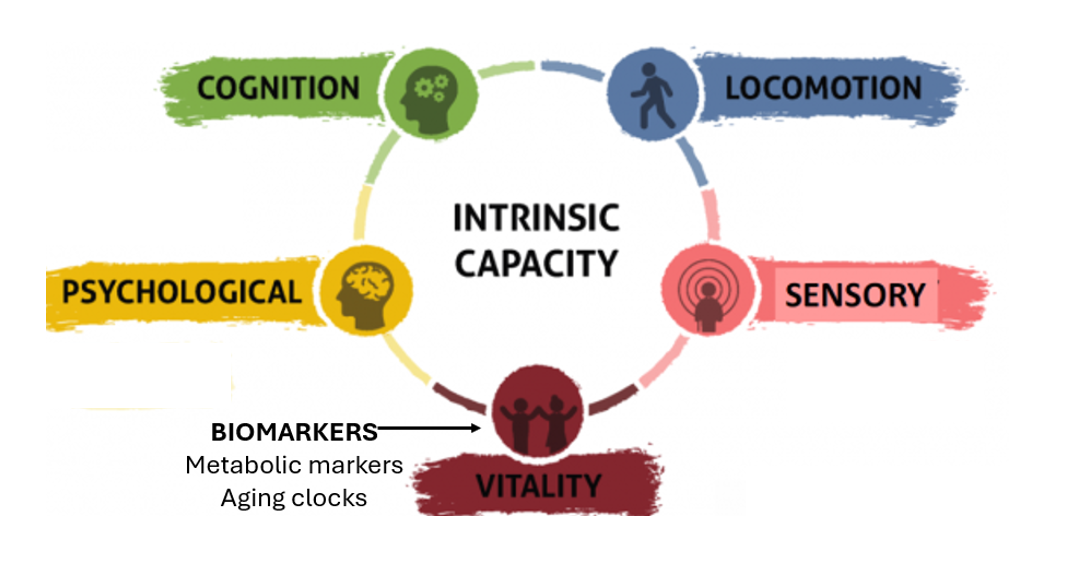
As people age, they experience a gradual decline in intrinsic capacity (IC), the combined physical and mental abilities that support independence and health. The World Health Organization recognizes IC as a central indicator of resilience in aging, yet no affordable, validated tool exists to measure it. Current healthcare approaches focus on individual diseases or rely on costly private programs, and clinical trials remain slow because there is no reliable proxy for age-related functional decline.
The THRIVE team, led by Dr. Michael Snyder, Director of the Center for Genomics and Personalized Medicine at Stanford University in collaboration with the Buck Institute for Research on Aging, and Methuselah Foundation, along with study partners including Whoop, YMCA, and OpenCures, brings together leading experts in longevity science to address this gap, backed by an award of up to $34.5 million from the Advanced Research Projects Agency for Health (ARPA-H).
“We lack quantitative measures for resilience and health. Our team will build quantitative science-based measures that predict long-term outcomes with the ultimate goal of keeping people healthy.” said Dr. Snyder.
The coalition will develop a PROSPR Intrinsic Capacity score that predicts 20-year outcomes including mortality, multimorbidity, hospitalization, and loss of functional ability. The score will integrate health surveys, functional assessments, continuous wearable data (powered by Whoop), and blood-based biomarkers across large longitudinal datasets, spanning millions of data points, to generate a robust predictor of future health trajectory up to 20 years ahead. Researchers will translate this score into a streamlined at-home assessment kit, enabling accessible, scalable, population-level monitoring at a sub-$100 price point.
“With PROSPR, we're enabling the first-ever clinical trials that truly target aging," says Andrew Brack, ARPA-H Program Manager and creator of the PROSPR program. "To avoid decades-long studies, we must identify a short-term, reliable and intervenable surrogate that predicts longer-term changes in health, and that's why THRIVE is an essential key to the program's success."
"The longevity sector has been paralyzed by a lack of FDA-grade endpoints," said Dane Gobel, Co-Founder of the Methuselah Foundation. "With the PROSPR platform, we are building the diagnostic infrastructure to prove that aging is quantifiable and treatable. We aren't just running a study—we are building the operating system for the future of human health."
To validate the PROSPR IC score, the THRIVE team will conduct a series of massive 1,000+ person decentralized observational and lifestyle intervention trials in partnership with the YMCA, using OpenCures as the underlying clinical trial platform. The trials will involve a diverse U.S. population to determine whether improvements in diet, exercise, sleep, stress management, and social engagement measurably improve intrinsic capacity. This approach could shift healthcare from reacting to disease toward preserving function and resilience before decline occurs. Beyond individual health, the PROSPR IC score could accelerate clinical trials by providing a responsive FDA-approved measure of age-related decline, reducing the time required to evaluate new therapies from decades to years.
“This moonshot program integrates, for the first time, molecular biomarkers with functional features of aging at scale to predict long-term health outcomes. It is built on the recognition that decline in intrinsic capacity is a disease-relevant condition. By converging gerontology and geroscience, we’re bringing together three highly experienced bio-computational teams, a dedicated software engineering group and an experienced clinical team to generate next-generation predictors and therapeutics for functional aging decline,” said Dr. David Furman, Professor and Bioinformatics Director at the Buck Institute for Research on Aging. “This is likely one of the most impactful federally funded efforts to extend the healthspan of all of us. I couldn’t be more excited to get this started.”
“PROSPR is redefining how we measure and protect the capacity that truly matters as we age. We’re building the scientific foundation to measure intrinsic capacity with the same rigor we measure blood pressure or cholesterol — because what we can measure, we can improve. Through decentralized clinical trials and YMCA-based lifestyle interventions, we’re moving aging science out of the ivory tower and into communities, creating scalable strategies to preserve resilience and extend healthspan,” said Dr. Brianna Stubbs, Clinical Lead at the Buck Institute for Research on Aging.
Media contact: Stanford University
Mohan Babu
bvmbabu@stanford.edu
650-507-9864
Media contact:
Kris Rebillot
Senior Director of Communications
Buck Institute for Research on Aging
(415) 209-2080
krebillot@buckinstitute.org
About Methuselah Foundation: Founded in 2001, the Methuselah Foundation is a pioneering 510 (c)(3) nonprofit established to incentivize scientific progress towards extending the healthy human lifespan. The Foundation incubates and sponsors mission-critical ventures, scientific research, and crowdsourced innovation prizes --- from early investments in regenerative medicine to designing and running NASA life science open innovation challenges. For more information visit mfoundation.org
Media contact:
Dane Gobel
206-613-9364
dane.gobel@mfoundation.org
Science is showing that while chronological aging is inevitable, biological aging is malleable. There's a part of it that you can fight, and we are getting closer and closer to winning that fight.
Eric Verdin, MD, Buck Institute President and CEO